
ANN assisted TPS on capped alanine dipeptide 1#
In this notebook you will learn:
how to setup an ANN assisted TPS simulation on a simple molecular system
how to transform atomistic input coordinates to the descriptor space in which the ANN learns
This notebook assumes some familiarity with openpathsampling and aimmd, please do the Toy notebooks first.
# to be able tu run multiple notebooks in paralell:
# tell tf to not grab the whole GPU memory available
import tensorflow as tf
if tf.version.VERSION.startswith('2.'):
    # tell tf to use only the GPU mem it needs
    gpus = tf.config.experimental.list_physical_devices('GPU')
    print('available GPUs: ', gpus)
    for gpu in gpus:
        tf.config.experimental.set_memory_growth(gpu, True)
    from tensorflow.keras import backend as K

else:
    conf = tf.compat.v1.ConfigProto()
    conf.gpu_options.allow_growth = True
    conf.gpu_options.per_process_gpu_memory_fraction = 0.25
    #tf.enable_eager_execution(config=conf)\n",
    sess = tf.compat.v1.Session(config=conf)
    from tensorflow.keras import backend as K
    K.set_session(sess)
available GPUs: [PhysicalDevice(name='/physical_device:GPU:0', device_type='GPU')]
%matplotlib inline
import os
import aimmd
import numpy as np
import mdtraj as md
import matplotlib.pyplot as plt
plt.rcParams['figure.figsize'] = 9, 6  # make the figures a bit bigger
import openpathsampling as paths
import openpathsampling.engines.openmm as peng_omm
import simtk.openmm as mm
import simtk.unit as unit
from simtk.openmm import app
from openmmtools.integrators import VVVRIntegrator
# setup logging
# executing this file sets the variable LOGCONFIG, which is a dictionary of logging presets
%run ../resources/logconf.py
# name our logfiles
LOGCONFIG['handlers']['stdf']['filename'] = 'ala_keras_simulation.log'
LOGCONFIG['handlers']['initf']['filename'] = 'ala_keras_init.log'
cur_dir = os.path.abspath(os.getcwd())  # needed to find our initial TP later
# change to the working directory of choice
wdir = '/home/tb/hejung/DATA/aimmd_scratch/SimData_keras_ala/'
#wdir = None
if wdir is not None:
    if not os.path.isdir(wdir):
        os.mkdir(wdir)
    os.chdir(wdir)

# setup logging in that directory
import logging.config
logging.config.dictConfig(LOGCONFIG)
initial TP and states#
Generating the initial TP is out of scope of this tutorial, please consult the openpathsampling examples for that.
# load initial TP for ala (generated at high temp, 400K)
# we load the h5py trajectory and define the states from scratch
# for better machine interoperability and smaller footprint in repo
initialTP_md = md.load(os.path.join(cur_dir, 'ala_400K_TP_low_barrier.h5'))
initialTP = peng_omm.trajectory_from_mdtraj(initialTP_md)
template = peng_omm.snapshot_from_pdb(os.path.join(cur_dir, "AD_initial_frame.pdb"))

# define the CVs
psi = paths.MDTrajFunctionCV("psi", md.compute_dihedrals, template.topology, indices=[[6,8,14,16]])
phi = paths.MDTrajFunctionCV("phi", md.compute_dihedrals, template.topology, indices=[[4,6,8,14]])

# define the states
deg = 180.0/np.pi
C_7eq = (paths.PeriodicCVDefinedVolume(phi, lambda_min=-180/deg, lambda_max=0/deg,
                                     period_min=-np.pi, period_max=np.pi) &
         paths.PeriodicCVDefinedVolume(psi, lambda_min=120/deg, lambda_max=200/deg,
                                     period_min=-np.pi, period_max=np.pi)
        ).named("C_7eq")

alpha_R = (paths.PeriodicCVDefinedVolume(phi, -180/deg, 0/deg, -np.pi, np.pi) &
           paths.PeriodicCVDefinedVolume(psi, -50/deg, 30/deg, -np.pi, np.pi)).named("alpha_R")
engine setup#
forcefield = app.ForceField('amber99sbildn.xml', 'tip3p.xml')
pdb = app.PDBFile(os.path.join(cur_dir, "AD_initial_frame.pdb"))
system = forcefield.createSystem(pdb.topology,
                                 nonbondedMethod=app.PME,
                                 nonbondedCutoff=1.0*unit.nanometers,
                                 constraints=app.HBonds,
                                 rigidWater=True,
                                 ewaldErrorTolerance=0.0005
                                 )
integrator = VVVRIntegrator(300*unit.kelvin,  # T
                            1.0/unit.picoseconds,  # fric
                            2.0*unit.femtoseconds)  # dt
integrator.setConstraintTolerance(0.00001)
engine_options = {
    'n_frames_max': 20000,
    'nsteps_per_frame': 10,
}
engine = peng_omm.Engine(template.topology,
                         system,
                         integrator,
                         options=engine_options
                         )
engine.name = '300K'
Transforming atomistic coordinates to training descriptors: Symmetry functions and internal coordinates#
# The slow part: symmetry functions

# symmerty functions first
cutoff = 0.6 # consider G5 worst case scenarios for cutoff!
# g2_parms are expected to be a list of lists, each sublist needs to contain [eta, r_s]
g2_parms = [[200., 0.1], [200., 0.25], [200., 0.4]]#, [200., 0.55], [200., 0.7], [200., 0.85]]

# g5_parms are also expected to be a list of lists, here each sublist needs to contain
# [eta, r_s, zeta, lambda]
# here we just create the list of [eta, r_s] for G5,
# we add the missing parmeters below since:
# we use the same zetas, which influence the sharpness of the angular peaks, for all G5s at different probing radii
# and we use the same two lambda values [-1, +1], which influence the location of the maximum, i.e. at angle=0 or at angle=\pi
g5_etas_rs = [[120., 0.1],
              [120., 0.25],
              [120., 0.4],
              #[120., 0.55],
              #[120., 0.7],
              #[120., 0.85]
             ]
# all zetas for all G5, high zeta means sharp angular resultion
# Note: zeta must be an even number, using these powers of 2 empirically works well
zetas = [
        1,
        2,
        4,
        16,
        64,
        ]
# construct g5_parms from previously defined values
# combine every eta, r_s with all zetas and both possible lambda values
g5_parms = [[eta, r_s, zeta, lamb] for (eta, r_s) in g5_etas_rs for zeta in zetas for lamb in [+1., -1.]]

# combine G2 and G5 params into one list to pass to the SF transformation function
g_parms = [g2_parms, g5_parms]

mol_idxs, solv_idxs = aimmd.coords.symmetry.generate_indices(template.topology.mdtraj,
                                                            ['HOH'],
                                                            solvent_atelements=[['O', 'H']],
                                                            reactant_selection='not resname HOH')

sf_parms = {'mol_idxs': mol_idxs, 'solv_idxs': solv_idxs, 'g_parms': g_parms,
            'cutoff': cutoff, 'n_per_solv': [[1., 2.]], 'rho_solv': [33.]}

sf_transform = paths.MDTrajFunctionCV('sf_transform', aimmd.coords.symmetry.transform,  # transform is an alias for sf
                                      template.topology, **sf_parms)
# The fast part: internal coordinates

pairs, triples, quadruples = aimmd.coords.internal.generate_indices(template.topology.mdtraj, source_idx=0)

ic_parms = {'pairs': pairs, 'triples': triples, 'quadruples': quadruples}

ic_transform = paths.MDTrajFunctionCV('ic_transform', aimmd.coords.internal.transform,  # transform is an alias for ic
                                      template.topology, **ic_parms)
# set this to True to do the full setup with symmetry functions, will be much slower
# leave it at False and we will not calculate any symmetry functions and train on internal coords only
# setting this to True will increase runtime by a factor of approximately 10 (depending on the choice of symmetry function cutoff)
we_have_time = True

if we_have_time:
    # create this little helper function to concatenate the descriptors we are interested in
    def transform_func(mdtra, sf_parms, ic_parms):
        import mdtraj as md
        from aimmd.coords.symmetry import sf
        from aimmd.coords.internal import ic
        import numpy as np
        return np.concatenate([ic(mdtra, **ic_parms),
                               sf(mdtra, **sf_parms),
                               ],
                              axis=1)

    descriptor_transform = paths.MDTrajFunctionCV('descriptor_transform', transform_func,
                                                  template.topology,
                                                  sf_parms=sf_parms,
                                                  ic_parms=ic_parms,
                                                  cv_scalarize_numpy_singletons=False)
else:
    # create this little helper function to concatenate the descriptors we are interested in
    def transform_func(mdtra, ic_parms):
        import mdtraj as md
        from aimmd.coords.internal import ic
        import numpy as np
        return ic(mdtra, **ic_parms)

    descriptor_transform = paths.MDTrajFunctionCV('descriptor_transform', transform_func,
                                                  template.topology,
                                                  ic_parms=ic_parms,
                                                  cv_scalarize_numpy_singletons=False)
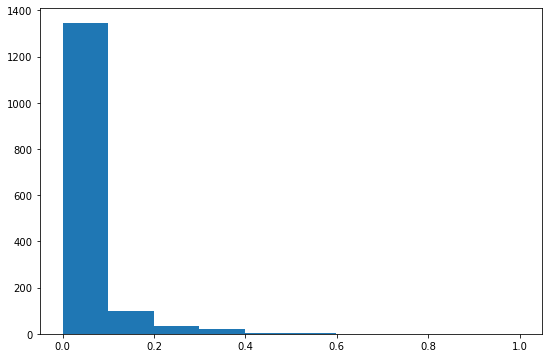
# lets have a look a the transformed coordinate values
# they should be all approximately in [0, 1]
trans_coords = descriptor_transform(template)
# also set cv_ndim, because this will be the number of network inputs
cv_ndim = trans_coords.shape[0]
plt.hist(trans_coords);
print('number of input descriptors: ', cv_ndim)
number of input descriptors: 1507
aimmd setup: create an ANN, RCModel, etc#
from tensorflow.keras import optimizers, regularizers
# use an aimmd utility function to create a pyramidal arch with a ResNet top part
# you could however wrap any keras model that has been compiled with an optimizer in an aimmd RCModel in the next cell
n_lay_pyramid = 4
n_unit_top = 10
n_lay_top = 2
n_unit_base = descriptor_transform(template).shape[0]
print('number of input descriptors: ', n_unit_base)

fact = (n_unit_top / n_unit_base)**(1./(n_lay_pyramid-1))

hidden_parms = []
for i in range(n_lay_pyramid):
    hidden_parms += [{'units': max(n_unit_top, int(n_unit_base * fact**i)),
                     'activation': 'selu', # elu; selu is good!
                     'use_bias': True,
                     'kernel_initializer': 'lecun_normal',
                     'bias_initializer': 'lecun_normal',
                     'kernel_regularizer': None,#regularizers.l1(l=0.0001),
                     'bias_regularizer': None,
                     'activity_regularizer': None,
                     'kernel_constraint': None,
                     'bias_constraint': None,
                     'dropout': 0.15 * fact**i,
                     }
                    ]
for i in range(n_lay_top):

    hidden_parms += [{'units': n_unit_top,
                     'activation': 'elu',
                     'use_bias': True,
                     'kernel_initializer': 'lecun_normal',
                     'bias_initializer': 'lecun_normal',
                     'kernel_regularizer': None,# regularizers.l1(l=0.0001),
                     'bias_regularizer': None,
                     'activity_regularizer': None,
                     'kernel_constraint': None,
                     'bias_constraint': None,
                     'dropout': None,
                     'residual_n_skip': 4,
                     }
                    ]


optimizer = optimizers.Adam(lr=0.001)
# create a ResNet with binomial loss to predict p_B
resnet = aimmd.keras.create_resnet(ndim=n_unit_base, hidden_parms=hidden_parms,
                                  optimizer=optimizer,
                                  n_states=2,  # does not really matter if multi_state=False
                                  multi_state=False)
number of input descriptors: 1507
aimmd_store = aimmd.Storage(os.path.join(wdir, 'aimmd_storage.h5'), mode='w')
# we take an ExpectedEfficiencyPytorchRCModel,
# this RCmodel scales the learning rate by the expected efficiency factor (1 - n_TP_true / n_TP_expected)**2
model = aimmd.keras.EEScaleKerasRCModel(nnet=resnet,
                                        states=[C_7eq, alpha_R],
                                        descriptor_transform=descriptor_transform,
                                        ee_params={'lr_0': 0.001,
                                                   'lr_min': 0.00005,  # lr_min = lr_0 / 20 is a good choice empirically
                                                   'epochs_per_train': 4,
                                                   'interval': 5,
                                                   'window': 75,
                                                   },
                                        cache_file=aimmd_store,
                                       )
trainset = aimmd.TrainSet(n_states=2)
trainhook = aimmd.ops.TrainingHook(model, trainset)
storehook = aimmd.ops.AimmdStorageHook(aimmd_store, model, trainset)
densityhook = aimmd.ops.DensityCollectionHook(model)
selector = aimmd.ops.RCModelSelector(model=model,
                                    states=[C_7eq, alpha_R],
                                    distribution='lorentzian',
                                    scale=1.0,
                                    )
OPS setup: TPS strategy and sampled transitions#
network = paths.TPSNetwork.from_states_all_to_all([C_7eq, alpha_R])
move_scheme = paths.MoveScheme(network=network)
beta = 1.0 / (engine.integrator.getTemperature() * unit.BOLTZMANN_CONSTANT_kB)
modifier = paths.RandomVelocities(beta=beta, engine=engine)
tw_strategy = paths.strategies.TwoWayShootingStrategy(modifier=modifier,
                                                      selector=selector,
                                                      engine=engine,
                                                      group='TwoWayShooting')
move_scheme.append(tw_strategy)
move_scheme.append(paths.strategies.OrganizeByMoveGroupStrategy())
move_scheme.build_move_decision_tree()
initial_conditions = move_scheme.initial_conditions_from_trajectories(initialTP)
No missing ensembles.
No extra ensembles.
storage = paths.Storage('ala_LB_keras_ResNet.nc', mode='w', template=template)

sampler = paths.PathSampling(storage=storage,
                             sample_set=initial_conditions,
                             move_scheme=move_scheme)
sampler.attach_hook(trainhook)
sampler.attach_hook(storehook)
sampler.attach_hook(densityhook)
sampler.run(2000)
Working on Monte Carlo cycle number 2000
Running for 2 hours 1 minute 30 seconds -  3.65 seconds per step
Estimated time remaining: 3 seconds
DONE! Completed 2000 Monte Carlo cycles.
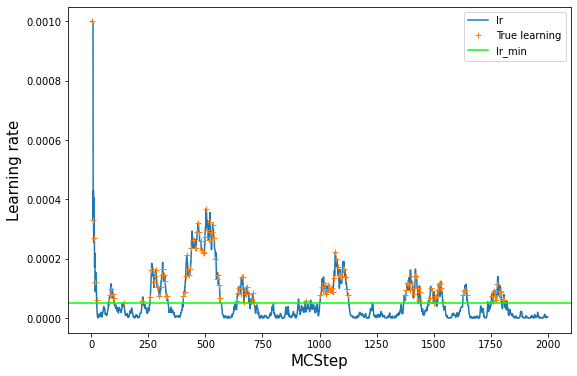
log_train = np.array(model.log_train_decision)
lr = log_train[:,1]
plt.plot(lr, label='lr')
# see where we really trained: everywhere where train=True
# set lr_true to NaN anywhere where we did not train to have a nice plot
lr_true = lr
lr_true[log_train[:,0] == False] = np.nan
plt.plot(lr_true, '+', label='True learning')
# lr_min as a guide to the eye
plt.axhline(model.ee_params['lr_min'], label='lr_min', color='lime')
plt.legend()
plt.xlabel('MCStep', size=15);
plt.ylabel('Learning rate', size=15);
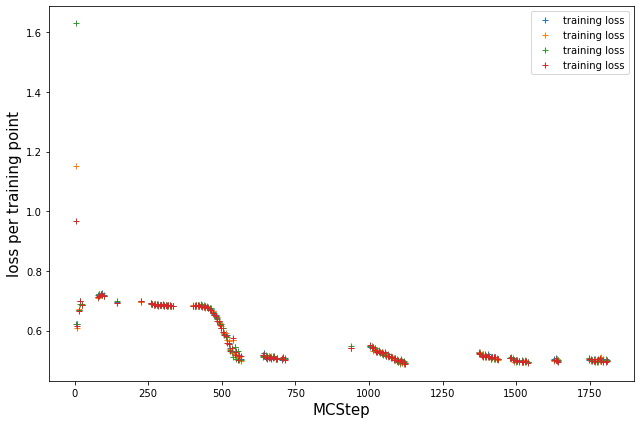
# resort such that we have a loss value per MCStep, NaN if we did not train at that step
train_loss = []
count = 0
for t in log_train[:, 0]:
    if t:
        train_loss.append(model.log_train_loss[count])
        count += 1
    else:
        train_loss.append([np.nan for _ in range(model.ee_params['epochs_per_train'])])

plt.plot(train_loss, '+', label='training loss')
plt.legend();
plt.ylabel('loss per training point', size=15)
plt.xlabel('MCStep', size=15)
plt.tight_layout()
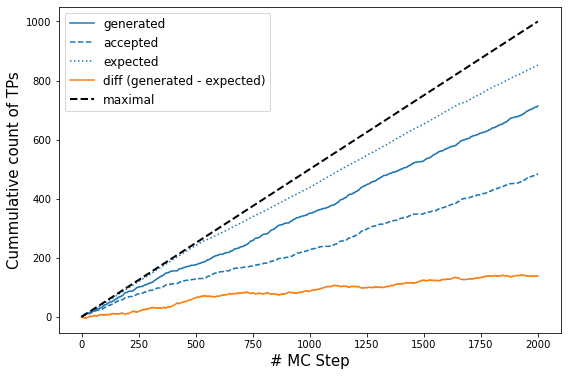
# get the number of accepts from OPS storage
accepts = []
for step in storage.steps:
    if step.change.canonical.accepted:
        accepts.append(1.)
    else:
        accepts.append(0.)
p_ex = np.array(model.expected_p)

l, = plt.plot(np.cumsum(trainset.transitions), label='generated');
plt.plot(np.cumsum(accepts), c=l.get_color(), ls='--', label='accepted');
plt.plot(np.cumsum(2*p_ex*(1 - p_ex)),c=l.get_color(), ls=':', label='expected');
plt.plot(np.cumsum(2*p_ex*(1 - p_ex))- np.cumsum(trainset.transitions), label='diff (generated - expected)')
plt.plot(np.linspace(0., len(trainset)/2., len(trainset)), c='k', ls='--', label='maximal', lw=2)
plt.legend(fontsize=12);
plt.ylabel('Cummulative count of TPs', size=15)
plt.xlabel('# MC Step', size=15);
HIPR#
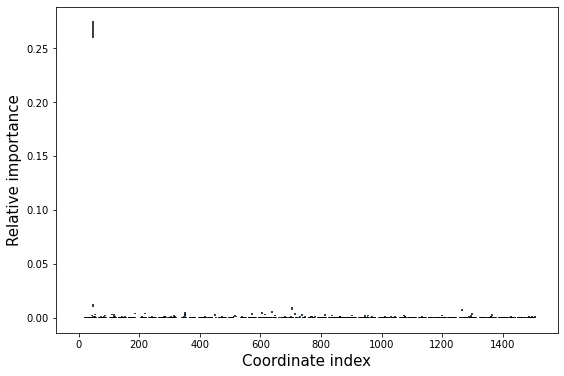
hipr = aimmd.analysis.HIPRanalysis(model, trainset)
hipr_plus_losses, hipr_plus_stds = hipr.do_hipr_plus(25)
loss_diffs = hipr_plus_losses[:-1] - hipr_plus_losses[-1]  # hipr_losses[-1] is the reference loss over the unaltered trainset

plt.bar(np.arange(len(loss_diffs)), loss_diffs, yerr=hipr_plus_stds[:-1])
plt.xlabel('Coordinate index', size=15)
plt.ylabel('Relative importance', size=15);
ic_parms["quadrouples"] = ic_parms["quadruples"]
# what are the most important contributors?
max_idxs = np.argsort(loss_diffs)[::-1]
sf_parms = descriptor_transform.kwargs['sf_parms']
ic_parms = descriptor_transform.kwargs['ic_parms']

print('reference loss:', hipr_plus_losses[-1])
for idx in max_idxs[:40]:
    print()
    print('loss for idx {:d}: '.format(idx), hipr_plus_losses[idx])
    print(aimmd.coords.get_involved(idx, sf_parms=sf_parms, ic_parms=ic_parms, solvent_atoms=[['O', 'H']], solvent_resname=['HOH']))
reference loss: 0.4989878237247467

loss for idx 48:  0.7660467290878296
('IC', ('cos', [6, 8, 14, 15]))

loss for idx 47:  0.5100106143951416
('IC', ('sin', [6, 8, 14, 15]))

loss for idx 704:  0.5074009466171264
('SF', ('G5', [120.0, 0.25, 64, -1.0], 19, 'HOH', 'O'))

loss for idx 1265:  0.5063236474990844
('SF', ('G5', [120.0, 0.25, 64, -1.0], 14, 'HOH', 'H'))

loss for idx 638:  0.5038898038864136
('SF', ('G5', [120.0, 0.25, 64, -1.0], 17, 'HOH', 'O'))

loss for idx 605:  0.5034584665298462
('SF', ('G5', [120.0, 0.25, 64, -1.0], 16, 'HOH', 'O'))

loss for idx 353:  0.5028022313117981
('SF', ('G2', [200.0, 0.25], 9, 'HOH', 'O'))

loss for idx 219:  0.5027276182174683
('SF', ('G5', [120.0, 0.4, 64, -1.0], 4, 'HOH', 'O'))

loss for idx 186:  0.5026985812187195
('SF', ('G5', [120.0, 0.4, 64, -1.0], 3, 'HOH', 'O'))

loss for idx 714:  0.5025678777694702
('SF', ('G5', [120.0, 0.4, 64, -1.0], 19, 'HOH', 'O'))

loss for idx 572:  0.5024674677848816
('SF', ('G5', [120.0, 0.25, 64, -1.0], 15, 'HOH', 'O'))

loss for idx 1298:  0.5020161890983581
('SF', ('G5', [120.0, 0.25, 64, -1.0], 15, 'HOH', 'H'))

loss for idx 110:  0.5019930195808411
('SF', ('G5', [120.0, 0.25, 64, -1.0], 1, 'HOH', 'O'))

loss for idx 54:  0.5018625879287719
('IC', ('cos', [14, 16, 18, 19]))

loss for idx 615:  0.5017547821998596
('SF', ('G5', [120.0, 0.4, 64, -1.0], 16, 'HOH', 'O'))

loss for idx 737:  0.50148876786232
('SF', ('G5', [120.0, 0.25, 64, -1.0], 20, 'HOH', 'O'))

loss for idx 118:  0.5014217233657837
('SF', ('G5', [120.0, 0.4, 16, -1.0], 1, 'HOH', 'O'))

loss for idx 1364:  0.5013529598712921
('SF', ('G5', [120.0, 0.25, 64, -1.0], 17, 'HOH', 'H'))

loss for idx 813:  0.5013305699825287
('SF', ('G5', [120.0, 0.4, 64, -1.0], 0, 'HOH', 'H'))

loss for idx 450:  0.5012381136417389
('SF', ('G5', [120.0, 0.4, 64, -1.0], 11, 'HOH', 'O'))

loss for idx 516:  0.5011262917518615
('SF', ('G5', [120.0, 0.4, 64, -1.0], 13, 'HOH', 'O'))

loss for idx 351:  0.5009903120994568
('SF', ('G5', [120.0, 0.4, 64, -1.0], 8, 'HOH', 'O'))

loss for idx 902:  0.5009245538711548
('SF', ('G5', [120.0, 0.25, 64, -1.0], 3, 'HOH', 'H'))

loss for idx 46:  0.5008585023880004
('IC', ('cos', [4, 6, 8, 14]))

loss for idx 836:  0.5007065236568451
('SF', ('G5', [120.0, 0.25, 64, -1.0], 1, 'HOH', 'H'))

loss for idx 1075:  0.5007018399238586
('SF', ('G5', [120.0, 0.4, 16, -1.0], 8, 'HOH', 'H'))

loss for idx 1199:  0.5006754302978516
('SF', ('G5', [120.0, 0.25, 64, -1.0], 12, 'HOH', 'H'))

loss for idx 316:  0.5006131601333618
('SF', ('G5', [120.0, 0.4, 16, -1.0], 7, 'HOH', 'O'))

loss for idx 954:  0.500596672296524
('SF', ('G5', [120.0, 0.1, 4, -1.0], 5, 'HOH', 'H'))

loss for idx 87:  0.5005046200752258
('SF', ('G5', [120.0, 0.4, 64, -1.0], 0, 'HOH', 'O'))

loss for idx 648:  0.5004878866672516
('SF', ('G5', [120.0, 0.4, 64, -1.0], 17, 'HOH', 'O'))

loss for idx 803:  0.5004625809192658
('SF', ('G5', [120.0, 0.25, 64, -1.0], 0, 'HOH', 'H'))

loss for idx 286:  0.5004577755928039
('SF', ('G2', [200.0, 0.1], 7, 'HOH', 'O'))

loss for idx 116:  0.5003732419013978
('SF', ('G5', [120.0, 0.4, 4, -1.0], 1, 'HOH', 'O'))

loss for idx 1296:  0.5003430426120759
('SF', ('G5', [120.0, 0.25, 16, -1.0], 15, 'HOH', 'H'))

loss for idx 45:  0.5003343033790588
('IC', ('sin', [4, 6, 8, 14]))

loss for idx 446:  0.5003123235702515
('SF', ('G5', [120.0, 0.4, 4, -1.0], 11, 'HOH', 'O'))

loss for idx 945:  0.5003120613098144
('SF', ('G5', [120.0, 0.4, 64, -1.0], 4, 'HOH', 'H'))

loss for idx 539:  0.5002900290489197
('SF', ('G5', [120.0, 0.25, 64, -1.0], 14, 'HOH', 'O'))

loss for idx 242:  0.5002531719207763
('SF', ('G5', [120.0, 0.25, 64, -1.0], 5, 'HOH', 'O'))
storage.sync_all()
storage.close()
aimmd_store.close()